.png)




El costo oculto (y humano) de los retrasos en el procesamiento de DACA

The Hidden (and Human) Cost of DACA Processing Delays
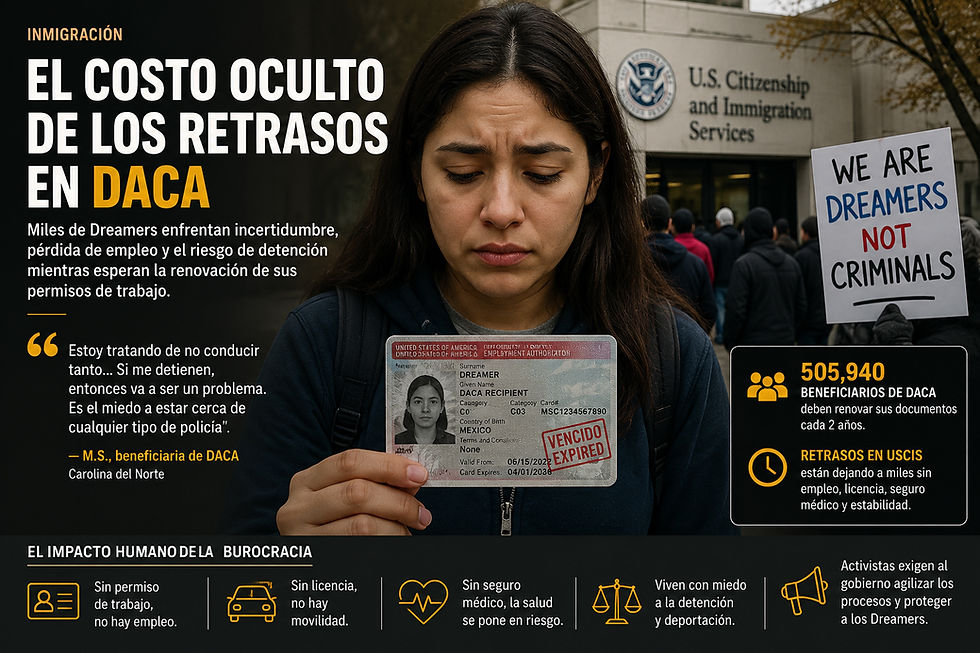
Mientras las renovaciones de DACA se estancan, los Dreamers encuentran apoyo en “salvavidas” en línea y enfrentan la posibilidad de desempleo, detención y deportación.
El costo oculto (y humano) de los retrasos en el procesamiento de DACA For
Dreamers waiting on DACA renewals, how much can change before the paperwork arrives?
Por Yesica Balderrama, @yesica_bald
Cuando M.S. conduce, se mantiene en las autopistas interestatales y carreteras principales, donde sabe que es menos probable que la detenga un oficial de policía, en Carolina del Norte. Las noticias de todo el país sobre las redadas del Servicio de Control de Inmigración y Aduanas (ICE) y los arrestos de inmigrantes indocumentados la han vuelto aprensiva a la hora de viajar, pero quedarse en casa no es una opción.
When M.S. gets behind the wheel in North Carolina, she stays on interstates and main roads, where she knows she is less likely to be stopped by a police officer. The news from around the country about Immigration and Customs Enforcement (ICE) raids and the arrests of undocumented immigrants has made her apprehensive about traveling, but staying at home is not an option.
Ella y su esposo, ambos indocumentados, tienen que conducir diariamente para transportar mercancías en camiones de carga desde los almacenes hasta los supermercados. M.S. habló bajo condición de anonimato, utilizando únicamente sus iniciales, para proteger su seguridad. Conducir es un riesgo que corren para seguir viviendo su vida lo más normalmente posible. El negocio familiar es su única fuente de ingresos.
She and her husband, both undocumented, have to drive daily to transport goods in box trucks from warehouses to supermarkets. M.S. spoke on the condition of anonymity, using only her initials, to protect their safety. Driving is a risk they take to continue living their life as normally as possible. The family-owned business is their sole source of income.
El permiso de trabajo y la licencia de M.S. expiraron a principios de abril de 2026, por lo que ha estado conduciendo sin ellos. Si hoy pudiera ser el día en que una parada de tráfico cambie su vida, ella no lo sabe.
M.S.’s work permit and license expired at the beginning of April 2026, so she has been driving without it. Whether today could become the day a traffic stop changes her life, she does not know.
“Por supuesto, existe el temor de que me detengan, así que estoy tratando de no conducir tanto”, dijo M.S. a palabra. “Estoy tratando de ir por caminos que sean más seguros, como no ir a un punto de control. Si me detienen, entonces va a ser un problema. Es el miedo a estar cerca de cualquier tipo de policía o de cualquiera que implique tener que mostrar documentación”.
“Of course, there is a fear that I'll get stopped, so I'm trying not to drive as much,” M.S. said to palabra. “I’m trying to go ways that are safer, like not going to a checkpoint. If I get stopped, then it's gonna be an issue. It’s fear of being near any type of cop or anybody that involves having to show documentation.”
M.S. es una beneficiaria de DACA de 35 años, originaria de Veracruz, México. Sus padres la trajeron a este país a los 10 años. Ella es una de los muchos “Dreamers” que esperan que el Servicio de Ciudadanía e Inmigración de los Estados Unidos (USCIS) procese la renovación de sus documentos.
M.S. is a 35-year-old DACA recipient from Veracruz, Mexico. Her parents brought her to this country at the age of 10. She is one of many “Dreamers” waiting for the U.S. Citizenship and Immigration Services (USCIS) to process her paperwork renewal.
La Acción Diferida para los Llegados en la Infancia (DACA) otorgó a los jóvenes indocumentados, traídos al país cuando eran niños, el derecho a quedarse y trabajar legalmente. Hay alrededor de 505.940 beneficiarios que tienen que renovar sus documentos cada dos años. Para miles de Dreamers, un permiso de trabajo vencido significa mucho más que papeleo. Están preocupados por sus medios de vida y por ser detenidos por el ICE.
Deferred Action for Childhood Arrivals (DACA) gave undocumented youth, brought to the country as children, the right to stay and work legally. There are about 505,940 recipients who have to renew their paperwork every two years. For thousands of Dreamers, an expired work permit means much more than paperwork. They are concerned about their livelihoods and about being detained by ICE.
Los beneficiarios y activistas entrevistados por palabra atribuyeron los retrasos a que el USCIS requiere que los beneficiarios presenten sus datos biométricos en persona como parte del proceso de verificación. Muchos Dreamers no han presentado datos biométricos desde su primera solicitud.
Recipients and activists interviewed by palabra attributed the delays to USCIS requiring recipients to submit their biometrics in person as part of the vetting process. Many Dreamers haven’t submitted biometrics since their first application.
“Hasta ahora me ha afectado porque tienes que tener una identificación válida para hacer algunas transacciones. Tenemos vehículos que están prácticamente todos a mi nombre”, dijo M.S. “El año pasado tuve que someterme a una cirugía de corazón. No tengo seguro en este momento porque no tengo una identificación válida. Eso se va a retrasar ahora”.
“So far, it has affected me because you have to have a valid ID to do some transactions. We have vehicles that are pretty much all under my name,” M.S. said. Last year, I had to have heart surgery. I don't have insurance at this moment because I don't have a valid ID. That’s gonna be delayed now.”
M.S. confía en que será aprobada, pero no sabe cuánto tiempo tomará. Las renovaciones están tardando más en procesarse y muchos están perdiendo sus empleos y beneficios debido a las tarjetas de autorización de empleo vencidas. La mayoría de los casos se resuelven en un plazo de cuatro meses, mientras que en el pasado tomaba de dos a seis semanas. Es un juego de espera difícil para la mayoría.
M.S. is confident she will be approved, but she doesn’t know how long it will take. Renewals are taking longer to process, and many are losing their jobs and benefits due to expired employment authorization cards. The majority of cases are resolved within four months, whereas in the past, it took about two to six weeks. It is a difficult waiting game for most.
M.S. da vueltas en la cama por las noches y su ansiedad crece cada día que pasa. Leerle a su hijo pequeño y preparar la comida para su familia por las noches la ayudan a salir adelante. Podría perder todo lo que ha trabajado para construir si no se aprueba la renovación de su permiso de trabajo: su casa, su familia y su negocio. Está pensando en cómo planificar para un futuro desconocido.
M.S. tosses and turns at night, and her anxiety grows each passing day. Reading to her toddler and preparing food for her family in the evenings helps her cope. She could lose everything she has worked to build if her work permit renewal is not approved— her home, her family, and her business. She is thinking about how to plan for an unknown future.
“Mi esposo y yo hemos considerado la posibilidad de regresar a nuestro país en el futuro. Actualmente estamos investigando oportunidades de bienes raíces y tomando cursos en línea como preparación, particularmente si no podemos resolver nuestro estatus migratorio dentro de los próximos cinco años aproximadamente”, explicó M.S.
“My husband and I have considered the possibility of returning to our country in the future. We are currently researching real estate opportunities and taking online courses in preparation, particularly if we are unable to resolve our immigration status within the next five years or so,” M.S. explained.
M.S. nunca ha sido arrestada, ha enviado sus documentos a tiempo en cada ocasión y su familia pagó $12.000 en impuestos en 2025. Es posible que tenga que vender su negocio o mudarse a un estado que sea más amigable con los inmigrantes si su renovación tarda más de lo previsto.
M.S. has never been arrested, has submitted her paperwork early every time, and her family paid $12,000 in taxes. She might have to sell her business or move to a state that is more immigrant-friendly if her renewal takes longer than expected.
“Estoy haciendo todas las cosas correctas que hace cualquiera que quiere ser legal. No hay nada que pueda hacer para solucionarlo”, dijo.
“I'm doing all the right things that anybody who wants to be legal is doing. There's nothing I can do to fix it,” she said.
Los beneficiarios crean solidaridad en línea
En grupos de Facebook con decenas de miles de miembros, los Dreamers encuentran comunidad, ayuda mutua, apoyo emocional y consejos. Se informan mutuamente, y a otras personas aliadas, sobre sus experiencias, cuánto tiempo están tardando las renovaciones de sus permisos de trabajo, y se recomiendan entre sí formas de salir adelante.
In Facebook groups with tens of thousands of members, Dreamers find community, mutual aid, emotional support, and advice. They inform each other and allies about their experiences, such as how long their work permit renewals are taking, and they recommend each other ways to make ends meet. ‘
Sienten aprehensión por realizar cualquier actividad que pueda revelar su estatus de indocumentados. En april de 2026, algunos Dreamers comentaban que dependen del autoempleo, del trabajo no registrado o del uso de sus ahorros para obtener ingresos. Los nombres de los grupos y de sus miembros no se muestran para protegerlos.
They are apprehensive about performing any activity that may disclose their undocumented status. Dreamers report relying on self-employment, working off the books, or using their savings for income. The names of the groups and their members are not shown to protect them.
“Hay muchas consecuencias que se derivan de perder DACA, incluso por un corto período de tiempo. Ha sido realmente un desafío ver la incertidumbre que siempre ha estado presente con DACA. La gente informa tener que planificar sus vidas cada 2 años porque realmente no sabes qué va a pasar cuando hay un cambio de administración”, dijo Ignacia Rodriguez Kmec, abogada y asesora de políticas en el National Immigration Law Center (NILC).
“There are a lot of consequences that come from losing DACA, even for a short period of time. It has been really challenging to see the uncertainty that has always been present with DACA. People report having to plan their lives 2 years at a time because you really don't know what's going to happen when there's a change in administration,” said Ignacia Rodriguez Kmec, a policy counsel at the National Immigration Law Center (NILC) and lawyer.
Kmec aconseja a los Dreamers enviar sus renovaciones 120 días antes de la fecha de vencimiento, guardar cualquier cambio en el estado de su caso y conocer sus derechos en el lugar de trabajo. Ella les recomienda compartir sus historias con un miembro del Congreso para presionarlo a tomar medidas en nombre de la comunidad de DACA.
Kmec advises Dreamers to submit their renewals 120 days before the expiration date, to save any changes to their case status, and to learn about their rights in the workplace. She encourages them to share their stories with a member of Congress to pressure them to take action on behalf of the DACA community.
Es un juego de espera
It’s a Waiting Game
Lo primero que hace Christian Vásquez frente a su computadora a las 7 a.m. cada mañana es revisar el estado de sus documentos. Más tarde, en su escritorio de trabajo, volverá a revisar durante el almuerzo y una vez más al final del día. No entiende por qué sus documentos tardan más en procesarse que los de otros que los enviaron después de él.
The first thing Christian Vasquez does at his computer at 7 a.m. every morning is check his paperwork status. Later at his work desk, he will check again during lunch and once more at the end of the day. He doesn’t understand why his paperwork is taking longer to process than others who submitted after him.
Han pasado más de cuatro meses desde que solicitó su renovación. Se ha puesto en contacto con el USCIS y se ha comunicado con su representante en el Congreso sin tener suerte.
It has been over four months since he filed for his renewal. He has reached out to USCIS and contacted his congressional representative without any luck.
El permiso de trabajo de Vásquez venció en mayo. Es un técnico de 31 años originario de Durango, México, que vive en Los Ángeles. Si no recibe pronto su tarjeta física actualizada, podría quedar desempleado. Su gerente le permite seguir trabajando a su discreción.
Vasquez’s work permit expired in May. He is a 31-year-old technician from Durango, Mexico, living in Los Angeles. If he does not get his updated physical card soon, he could be unemployed. His manager is letting him continue working at his discretion.
“Mi gerente regional me escribió una carta, explicando por qué yo era importante para la empresa y por qué deberían considerar renovar mi permiso de trabajo más rápido, para que de esa manera no pierda mi trabajo. Presenté la carta como evidencia de respaldo para ver si eso ayudaba”, dijo Vásquez. “No me dejarán seguir trabajando incluso si muestro la carta de aprobación porque en realidad quieren la copia física de la autorización de trabajo”.
“My regional manager wrote me a letter, like why I was important to the company and why they should consider renewing my work permit faster, that way I don't lose my job. I submitted the letter as supporting evidence to see if that helped,” said Vasquez, “They won't let me continue working even if I show the approval letter because they actually want the physical copy of the work authorization.”
Investigaciones demuestran que alrededor del 92% de los beneficiarios de DACA están empleados y pagan un estimado de $2.1 mil millones anuales al Seguro Social y al Medicare.
Research showed about 92% DACA recipients are employed and pay an estimated $2.1 billion annually to Social Security and Medicare — programs that benefit all Americans.
Mientras Vásquez espera, está preparado para recurrir al trabajo no registrado si es necesario. A sus 20 años, Vásquez fue un empleado indocumentado en Compton, California. El pequeño almacén no tenía ventanas ni aire acondicionado. Él y sus dos compañeros de trabajo bebían agua para mantenerse hidratados en la habitación sofocante, calurosa y desordenada donde reorganizaban y almacenaban bombillas, cables, paneles eléctricos y otros suministros. Le pagaban aproximadamente la mitad de lo que gana ahora.
While Vasquez waits, he is prepared to work off the books if necessary. In his 20s, Vasquez was an undocumented employee in Compton, California. The small warehouse didn’t have windows or air conditioning. He and his two coworkers drank water to stay hydrated in the stuffy, hot, cluttered room where they rearranged and stocked lightbulbs, cords, electrical panels, and other supplies. It paid him about half of what he is earning now.
“Simplemente estoy dejando que las cosas pasen porque no estoy tratando de estar todo estresado o ansioso. Siento que a mucha gente, una vez que pierden su permiso de trabajo, se les bloquea la mente y no saben qué hacer porque solo han trabajado con DACA”, explicó Vásquez.
“I'm just letting things be because I'm not trying to be all stressed or anxious. I feel like a lot of people, once they lose their work permit, it shuts their minds off, and they don't know what to do because they have only worked with DACA,” Vasquez explained.
Desde su creación en 2012, miles se han incorporado a la fuerza laboral y han realizado contribuciones significativas a la economía. Las investigaciones demostraron que alrededor del 92% están empleados y pagan un estimado de $2.1 mil millones anuales al Seguro Social y al Medicare, programas que benefician a todos los estadounidenses.
Las cifras demuestran las pérdidas financieras potenciales si DACA fuera rescindido.
Since its creation in 2012, thousands have entered the workforce and made significant contributions to the economy. Research showed about 92% are employed and pay an estimated $2.1 billion annually to Social Security and Medicare-– programs that benefit all Americans. The figures demonstrate potential financial losses if DACA were to be rescinded.
Lo que están haciendo las organizaciones sin fines de lucro
What Nonprofits Are Doing
“Esto no debería estar sucediendo. Los beneficiarios de DACA han estado renovando su estatus durante la mayor parte de una década, por lo que el gobierno los conoce bien. La idea de que tengan que pasar por una verificación extrema es un poco absurda”, dijo Juliana Macedo do Nascimento, directora adjunta de defensa y campañas en United We Dream (UWD).
“This should not be happening. DACA recipients have been renewing their status for the better part of a decade so they're well known to the government. The idea that they have to go through extreme vetting is kind of absurd,” said Juliana Macedo do Nascimento, deputy director of advocacy and campaigns at United We Dream (UWD).
“No hemos escuchado que haya ningún tipo de problema técnico o problema de procesamiento que explique por qué están ocurriendo estos retrasos”, explicó Kmec.
“We haven't heard that there is any kind of technical issue or processing issue that explains why these delays are happening,” explained Kmec.
Activistas de UWD y del NILC están abogando en nombre de los Dreamers. UWD es una gran organización comunitaria de inmigración sin fines de lucro dirigida por jóvenes. Ha defendido a DACA de los numerosos desafíos legales que ha enfrentado a lo largo de los años. Al principio, atribuyó los tiempos de procesamiento más lentos a prácticas de verificación más estrictas y a la retención de los documentos de los Dreamers de países etiquetados como de riesgo.
Activists from UWD and the NILC are advocating on behalf of Dreamers. UWD is a large grassroots immigration nonprofit run by youth. It has defended DACA from the many legal challenges it has faced over the years. At first it attributed the slower processing times to stricter vetting practices and holds on to the paperwork of Dreamers from countries labeled at-risk. According to USCIS September 2025 data, roughly 3,000 recipients have their applications on hold and will have to undergo a thorough vetting process.
Según datos de septiembre de 2025 del USCIS, aproximadamente 3.000 beneficiarios tienen sus solicitudes en espera y tendrán que someterse a un proceso de verificación exhaustivo.
“Sabemos que la administración tiene una agenda de deportación masiva. Cuando los ves retrasar las solicitudes de manera que la gente pierda sus empleos y su protección, los deja vulnerables. Eso es lo que nos preocupa: que esta administración esté retrasando las renovaciones a propósito para que puedan ser detenidas”, dijo Nascimento.
“We know that the administration has a mass deportation agenda. When you see them slow walking applications so that people lose their jobs and their protection, it leaves them vulnerable. That's what we're concerned about — that this administration is slow walking renewals on purpose so that they can be detained,” said Nascimento.
UWD y otras organizaciones sin fines de lucro de inmigración están rastreando quiénes están siendo arrestados y compartiendo los casos en línea. El año pasado, 261 beneficiarios fueron detenidos y 86 fueron deportados, según una carta del Departamento de Seguridad Nacional (DHS). El aumento de las cifras tiene a los Dreamers y a los defensores preocupados por el futuro de DACA.
UWD and other immigration nonprofits are tracking who is being arrested and sharing the cases online. Last year 261 recipients were detained, and 86 were deported, according to a letter by the Department of Homeland Security (DHS). The rising numbers have Dreamers and advocates concerned about the future of DACA.
La organización colaboró recientemente con políticos para alentar al gobierno a realizar una supervisión y rendición de cuentas sobre la lentitud en los tiempos de procesamiento. En abril, el representante Jesús “Chuy” García (demócrata por Illinois) y el representante Lou Correa (demócrata por California) encabezaron una carta firmada por 86 miembros enviada al DHS y al USCIS instándolos a abordar los retrasos. El mes anterior, el senador Dick Durbin (demócrata por Illinois) y la senadora Catherine Cortez Masto (demócrata por Nevada) escribieron una carta con peticiones similares. No han recibido respuesta.
The organization recently collaborated with politicians to encourage the government to perform oversight and accountability over slow processing times. In April, Rep. Jesús “Chuy” García (D-Ill.) and Rep. Lou Correa (D-Calif.) led a letter signed by 86 members sent to the DHS and USCIS urging them to address the delays. The previous month Sen. Dick Durbin (D-Ill.) and Sen. Catherine Cortez Masto (D-Nev.) wrote a letter with similar requests. They have not received a response.
Palabra se comunicó con el USCIS para preguntar por qué se están retrasando las renovaciones de DACA y qué está haciendo el gobierno para mejorar los tiempos de procesamiento. Aquí hay un extracto de los comentarios: “El USCIS está salvaguardando al pueblo estadounidense mediante una evaluación y verificación más exhaustiva de todos los extranjeros. DACA no otorga ninguna forma de estatus legal en este país. Los extranjeros ilegales que afirman ser beneficiarios de DACA no están protegidos automáticamente de la deportación”.
Palabra reached out to USCIS to ask why DACA renewals are being delayed and what the government is doing to improve processing times. Here is an excerpt of USCIS’s comments: “USCIS is safeguarding the American people by more thoroughly screening and vetting all aliens. DACA does not confer any form of legal status in this country. Illegal aliens claiming to be recipients of DACA are not automatically protected from deportation.”
“DACA no fue suficiente. Se suponía que lo sería y ahora está desactualizado”, dijo Nascimento.
“DACA was not enough. It was supposed to be, and now it's outdated,” said Nascimento.
Resumen (40 segundos)
Miles de beneficiarios de DACA viven hoy una creciente incertidumbre debido a los retrasos en la renovación de sus permisos de trabajo. Mientras esperan la respuesta de USCIS, muchos han perdido sus empleos, licencias de conducir, seguro médico y estabilidad económica. Organizaciones defensoras advierten que estas demoras también aumentan el riesgo de detención y deportación para los Dreamers, quienes continúan aportando miles de millones de dólares a la economía estadounidense. El reportaje muestra el impacto humano detrás de la burocracia y el llamado de activistas para agilizar el procesamiento y brindar mayor protección a esta comunidad.


Comments