.png)



Nostalgia por los Mundiales

Nostalgia for the World Cups

OPINIÓN | Antes de la codicia corporativa, el cinismo político y las zonas VIP, las copas de fútbol se sentían más cercanas. ¿Seguirá siendo de todos el fútbol?
OPINION | Before corporate greed, political cynicism, and VIP areas, soccer world cups felt more personal. Will “fútbol” continue to belong to everyone?
Click here to read in English.
Texto y fotos por Rodrigo Cervantes, @RODCERVANTES
CIUDAD DE MÉXICO — Hace no mucho tiempo, la Copa del Mundo parecía una celebración más cercana a la gente. Las ciudades se convertían en enormes verbenas populares con residentes locales y turistas por igual. El festejo se percibía verdaderamente universal, siendo o no fanático del fútbol.
MEXICO CITY — Not too long ago, the World Cup seemed like a celebration closer to the

people. Cities transformed into enormous street parties with locals and tourists alike. The festivities felt truly universal, whether you were a soccer fan or not.
Los que presenciamos otros mundiales en México, por ejemplo, recordaremos que los boletos eran accesibles. Hace unos días, el galardonado director Alejandro González Iñárritu comentaba cómo su padre pudo asistir al Mundial con recursos modestos.
Those of us who attended other World Cups in Mexico, for example, will remember that tickets were affordable. A few days ago, award-winning director Alejandro González Iñárritu commented on how his father was able to attend the World Cup with modest resources.
La anécdota resume algo que muchos aficionados sienten hoy: una nostalgia que, más allá de los partidos memorables, recuerda una época en la que la experiencia estaba menos condicionada por la avaricia de los organizadores.
The anecdote sums up something that many fans feel today: a nostalgia that, beyond the memorable matches, recalls a time when the experience was less conditioned by the greed of the organizers.
Pero esta será la Copa más cara en la historia. Los boletos cuestan el doble de lo que costaban en Catar 2022 y cuatro veces más que en Estados Unidos 1994, de acuerdo con The Economist. El presidente de la FIFA, Gianni Infantino (sí, el mismo que le dio un “Premio de la Paz” a Donald Trump), cínicamente declaró que esperan generar el equivalente a 104 Supertazones. La gran pérdida de la fiesta del fútbol será quizás en las gradas, con una proyectada baja asistencia y aficionados enfrentando limitaciones a sus festejos, incluyendo la prohibición de cornetas y vuvuzelas.

But this will be the most expensive World Cup in history. Tickets cost twice as much as they did for Qatar 2022 and four times more than for the USA 1994, according to The Economist. FIFA President Gianni Infantino (yes, the same one who gave Donald Trump a “Peace Prize”) cynically stated that they expect to generate the equivalent of 104 Super Bowls.
The biggest loss to the soccer festival will perhaps be in the stands, with a projected low attendance and fans facing restrictions on how they can celebrate, including a ban on horns and vuvuzelas.
Anteriormente, el torneo conservaba la sensación de pertenecer al mundo entero sin distinciones, trayendo esperanza. Recuerdo que, durante el Mundial de México 86, muchos restaurantes y bares estrenaban la entonces nueva tecnología de “pantallas gigantes” para ver los partidos, convirtiendo estos lugares en espacios de armonía y convivencia. Asimismo, la Copa Mundial del 86 les servía a muchos habitantes de la Ciudad de México para sobrepasar emocionalmente las heridas profundas y el trauma del devastador sismo de 1985.
Previously, the tournament retained the feeling of belonging to the whole world without distinction, bringing hope. I remember that, during the 1986 World Cup in Mexico, many restaurants and bars introduced the then-new technology of "giant screens" for watching the matches, which transformed these places into spaces of harmony and community. The 1986 World Cup also helped many Mexico City residents emotionally overcome the deep wounds and trauma of the devastating 1985 earthquake.
Ahora, lo que prometía ser el mundial de la unión arrancó con el pie equivocado.
But now, what promised to be the world championship of unity got off to a bad start.
Luego de las controversias en Rusia 2018 y Catar 2022 tras señalamientos de discriminación y violaciones a los derechos humanos, un mundial con la alianza de las tres grandes naciones de América del Norte pintaba para regresarle a la copa de fútbol su esencia de paz y hermandad.
Following the controversies in Russia 2018 and Qatar 2022, after allegations of discrimination and human rights violations, a World Cup with the alliance of the three great North American nations seemed poised to return the soccer cup to its essence of peace and brotherhood.
Pero la realidad resultó otra, marcada principalmente por el voraz imperialismo de la administración Trump y su Doctrina Monroe 2.0, en la que Estados Unidos mantiene bajo amenaza a sus vecinos. Y, como ocurre con frecuencia en los grandes eventos deportivos, la llegada del Mundial se convierte en oportunidad para abrir al mundo una vitrina exhibiendo los problemas sociales locales.
But reality proved otherwise, marked primarily by the voracious imperialism of the Trump administration and its Monroe Doctrine 2.0, in which the United States keeps its neighbors under threat. And, as often happens with major sporting events, the arrival of the World Cup has become an opportunity to showcase local social problems to the world.
En Canadá, las protestas se han enfocado en los desplazamientos de vivienda y conflictos internacionales. En Estados Unidos crece la preocupación por las políticas migratorias

internas, las hostilidades bélicas en contra de Irán (cuyo equipo ni siquiera pudo hospedarse en EE.UU.) y el polarizante clima político.
In Canada, protests have focused on housing displacement and international conflicts. In the United States, concerns are growing about domestic immigration policies, the military hostilities against Iran (whose team couldn't even stay in the U.S.), and the polarizing political climate.
México es el único país con tres mundiales varoniles en su historia, lo cual debiera sentirse como un motivo de fiesta y orgullo. Pero la nación vive bajo decepciones sociopolíticas y económicas. La presidenta Claudia Sheinbaum anunció que cedería su lugar en la inauguración del Mundial en su país a dos niñas mexicanas como una medida más de corte populista que de desdén, probablemente temiendo las rechiflas y abucheos que sus antecesores enfrentaron en mundiales pasados.
Mexico is the only country with three men's World Cups in its history, which should be a cause for celebration and pride. But the nation is living through sociopolitical and economic disappointments. President Claudia Sheinbaum announced that she would give up her place at the World Cup opening ceremony in her country to two Mexican girls, a populist measure rather than one of disdain, probably fearing the jeers and boos that her predecessors faced in past World Cups.
Capital en caos Chaos in the capital

Bastaba con caminar por la Ciudad de México a solo días u horas de la inauguración del mundial en su Estadio Banorte (antes Azteca y ahora, por órdenes de la poderosa FIFA, Estadio Ciudad de México) para presenciar la apuesta del Gobierno por la forma más que por el fondo. It was enough to walk through Mexico City just days or hours before the opening of the World Cup at its Banorte Stadium (formerly Azteca and now, by order of the powerful FIFA, Mexico City Stadium) to witness the Government's commitment to form rather than substance.
Entre los más sonados ejemplos de la superficialidad gubernamental, focos de burlas y sátiras en las redes sociales, está la saturación de la ciudad con pintura morada y pintas de ajolotes que el gobierno capitalino ordenó, más allá de inversiones en soluciones viales y de servicios públicos.
Among the most notorious examples of governmental superficiality, sources of ridicule and memes on social media, there is a saturation of the city with purple paint and axolotl mascots that the city government ordered, ignoring the much needed investments in infrastructure and public services.
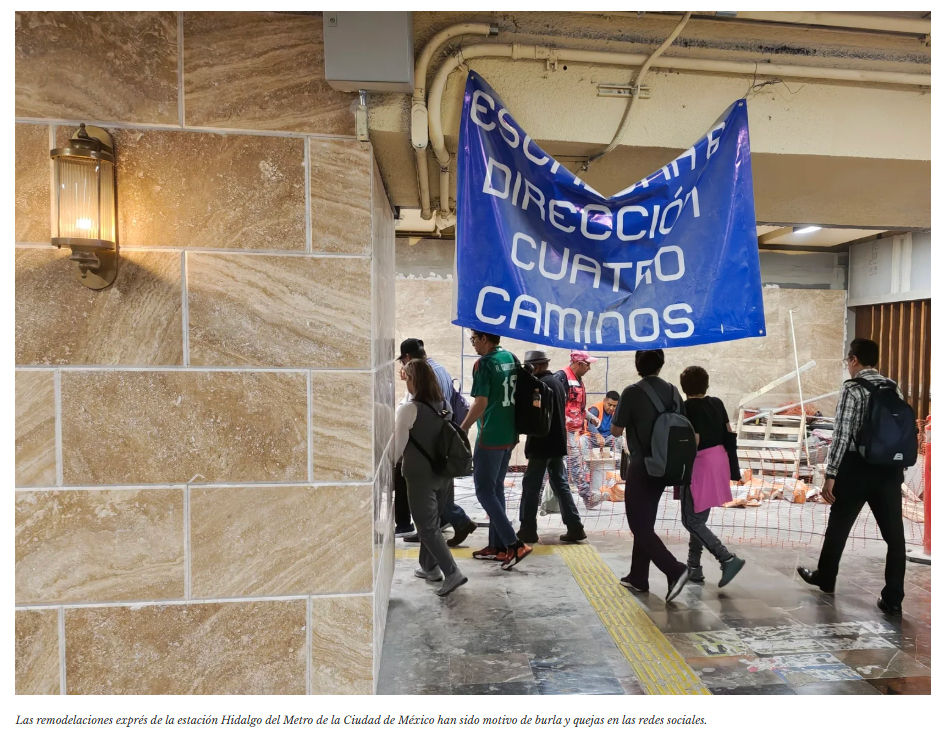
También destaca la remodelación kitsch de la estación Hidalgo del Metro con candelabros que parecieran salidos del musical de La Bella y La Bestia y acabados que pretenden imitar mármol fino de un palacete virreinal, todo lo cual se colocaba a marchas forzadas. Mientras tanto, millones de pasajeros sólo quieren llegar a su destino empleando un sistema de transporte seguro, eficiente y que no se vuelva a descarrilar.

Also noteworthy is the kitsch remodeling of the Hidalgo Metro station with chandeliers that looked like they came straight out of Beauty and the Beast and finishes that mimic the fine marble of a viceregal palace, all of which was being installed at breakneck speed. Meanwhile, millions of passengers just want to reach their destinations using a safe, efficient transportation system that won't derail again.
Sobre el Paseo de la Reforma, una de las principales arterias de la ciudad, las cosas tampoco lucen como el Gobierno quisiera. Los monumentos se ocultan tras vallas antimotines cubiertas con fotografías de personas desaparecidas por el crimen organizado, recordando la herida abierta que la administración Sheinbaum no ha querido o podido atender. Esa misma avenida fue revestida con flores de cempasúchil a modo de reflejar la identidad nacional. Pero en una de esas tristes ironías tan mexicanas, las flores propias de las festividades del Día de Muertos se convierten en tributos silentes de aquellos en las fotos de las vallas que no logran aparecer.
Along Paseo de la Reforma, one of the city's main avenues, things don't look as the government would like either. Monuments are hidden behind riot fences covered with photographs of people disappeared by organized crime, a stark reminder of the open wound that the Sheinbaum administration has been unwilling or unable to address. That same avenue was adorned with cempasúchiles, the bright orange Mexican marigolds, to reflect national identity. But in one of those sad, all-too-Mexican ironies, the flowers typical of the Day of the Dead festivities become silent tributes to those faces in the photos on the fences.
No deja de haber cierta nostalgia por aquello que hubo, pero también por lo que el Mundial de 2026 pudo y debió ser.
There is still a certain nostalgia for what once was, but also for what the World Cup of 2026 could and should have been.
La capital mexicana vive una realidad compleja, muy distinta a la que el Gobierno quiere proyectar con eventos como “hacer la ola más grande del mundo”.
Mexico City is experiencing a complex reality, very different from the one the government wants to project with events like “to make the biggest wave in the world.”
La verdadera ola es una marea de carpas y tiendas de campaña en las calles del Centro Histórico de la ciudad. Los campamentos de la Coordinadora Nacional de Trabajadores de la Educación (CNTE), el sindicato de maestros más grande y antiguo del país, mantienen su lucha por mejores condiciones salariales y pensiones en espera de que el gobierno los reciba, pero bajo la mirada de granaderos y policías.

The real wave is a tide of tents and canopies in the streets of the city's historic center. The encampments of the National Coordinator of Education Workers (CNTE), the country's largest and oldest teachers' union, continue their fight for better salaries and pensions, waiting for the government to meet with them, but under the watchful eyes of riot police and other police officers.
A los campamentos en el centro se suman otras barreras producto del control omnipotente de la FIFA durante el torneo. Las cuadras circundantes a la plaza mayor del Zócalo están rodeadas con altas vallas, mientras que policías y funcionarios públicos sin identificación regulan quién pasa y quién no. Lo que se supone será uno de los Fan Zones más grandes del mundo para ver los partidos acaba pareciendo la privatización del espacio público. Y, en medio de todo esto, turistas hospedados en el área navegan las calles, confundidos y agobiados, esquivando estos y otros obstáculos, como los charcos y baches.
In addition to the encampments in the city center, other barriers have been erected as a result of FIFA's omnipotent control during the tournament. The blocks surrounding the Zócalo's main square are enclosed by high fences, while police and unidentified public officials regulate who may or may not pass through. What is supposed to be one of the largest Fan Zones in the world for watching the matches ended up looking like the privatization of an important public space. And, amidst all this, tourists staying in the area navigate the streets, confused and overwhelmed, dodging these and other obstacles, such as puddles and potholes.
Alrededor del Estadio Ciudad de México, las obras avanzaban a marchas forzadas. El “Estadio Azteca” se reparó de forma exprés. Comerciantes y vendedores ambulantes alrededor observan, marginados y con incertidumbre, el lío que la Copa Mundial traerá. A las múltiples protestas que se vaticinan se espera también la de la Asociación de Titulares de Palcos y Plateas, que enfrenta una disputa legal con los dueños del inmueble ante las restricciones a su acceso al evento deportivo.
Around the Mexico City Stadium, remodeling works progressed at a fast pace. The “Estadio Azteca” was quickly repaired while shopkeepers and street vendors watch from the sidelines, uncertain of the chaos the World Cup would bring.
In addition to the numerous anticipated protests, another one is expected from the Association of Holders of Boxes and Grandstand Seats, who are facing a legal dispute with the stadium owners as a result of the restrictions on their access to the sporting event.
De todos… todavía
A lo mejor parecerá que estoy idealizando de alguna forma el pasado. Pero también es cierto que los mundiales de antes transmitían algo diferente para muchos de nosotros.
It might seem like I'm romanticizing the past. But it's also true that the World Cups in the past conveyed something different to many of us.
Tampoco quiero parecer pesimista ni pecar de pusilánime. Quizá las protestas hallarán negociación y los aficionados disfrutarán. Y lo más importante: a pesar de todo, el fútbol conserva su esencia popular, algo que ni la FIFA ni los patrocinadores han logrado expropiar por completo.
I don’t want to seem pessimistic or fainthearted, either. Perhaps the protests will find a solution, and the fans will find enjoyment. But most importantly: despite everything, soccer retains its popular essence, something that neither FIFA nor the sponsors have managed to completely expropriate.
Habrá algarabía y esperanza. Muchos festejarán goles legendarios o llorarán dolorosas derrotas. La fiesta, de una forma u otra, seguirá siendo de todos.
There will be joy and hope. Many will celebrate legendary goals. Others will suffer what may feel like tragic defeats. The celebration, in one way or another, will still belong to everyone.
Sin embargo, no deja de haber cierta nostalgia por aquello que hubo, pero también por lo que el Mundial de 2026 pudo y debió ser.
However, there is still a certain nostalgia for what once was, but also for what the World Cup of 2026 could and should have been.
Rodrigo Cervantes es un periodista bilingüe y estratega en comunicación galardonado y con amplia experiencia en Estados Unidos y México, entre otros países. Ha colaborado con medios como NPR, CNN, The Los Angeles Times y la BBC. Dirigió el buró en México de KJZZ, fundando la primera oficina internacional de una emisora de radio pública estadounidense. Fue editor general de la sección de Negocios de El Norte, parte de Grupo Reforma, uno de los principales grupos editoriales de México. En Georgia, EE.UU., dirigió la redacción de MundoHispánico, la publicación latina más antigua y de mayor circulación en el estado en ese entonces, perteneciente a The Atlanta Journal-Constitution. Su trabajo ha sido reconocido con premios Murrow de la RTDNA y José Martí de la Asociación Nacional de Publicaciones Hispanas (NAHP). Fue secretario de la Asociación Nacional de Periodistas Hispanos (NAHJ) y actualmente es co-director editorial de palabra, así como profesor adjunto en la Escuela de Periodismo y Comunicación W. Cronkite de la Universidad Estatal de Arizona (ASU). @RODCERVANTES
Rodrigo Cervantes is an award-winning bilingual journalist and communications strategist with extensive experience in the U.S., Mexico, and internationally. He has contributed to outlets such as NPR, CNN, The Los Angeles Times, and the BBC. Cervantes led KJZZ’s Mexico City bureau, where he launched the first overseas bureau for a U.S. public radio station. He also served as Business Editor-in-Chief for El Norte, part of Grupo Reforma, Mexico’s leading newspaper company. In Georgia, he led the newsroom of MundoHispánico, then the state’s oldest and largest Latino publication, under The Atlanta Journal-Constitution. His work has been recognized with RTDNA Murrow Awards and José Martí Awards from the National Association of Hispanic Publications (NAHP). He is the former Secretary of the National Association of Hispanic Journalists (NAHJ) and currently serves as co-managing editor of palabra, and as a clinical assistant professor at Arizona State University’s W. Cronkite School of Journalism and Mass Communication. @RODCERVANTES


Comments