.png)




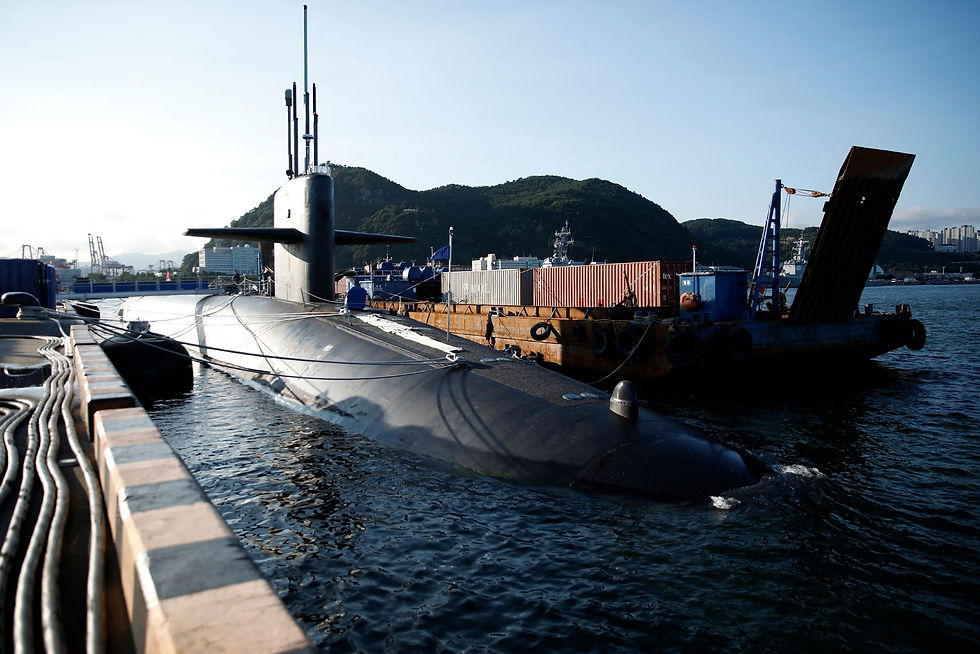
“Guerra Invisible” de Submarinos entre EU e Irán: Submarino de EU Torpedea Fragata de Irán con toda su Tripulación en las Costas de Sri Lanka

“Invisible War” of Submarines Between the US and Iran: US Submarine Torpedoes Iranian Frigate with Entire Crew Off the Coast of Sri Lanka

A los 5 días de la guerra de Israel/EU contra Irán los titulares de los multimedia occidentales---controlados aplastantemente por Israel---dieron vuelo al severo golpe que propino un submarino estadunidense a una fragata iraní con alrededor de 147 marinos---que se pueden dar por fallecidos o desaparecidos---en las costas de Sri Lanka, lo cual capturó la “atención” debido a la escalada en el “Gran Medio Oriente” ---de acuerdo a la definición del ex-General israelí Ariel Sharon, culpable de la masacre de palestinos en el campo de refugiados de Sabra y Chatila en Líbano en 1982---quien la definió con una LÍNEA HORIZONTAL desde Mauritania (en la parte oriental del océano Atlántico) hasta Cachemira ---donde cohabitan riesgosamente India/Pakistán/China--- y una LÍNEA VERTICAL que va desde el Cáucaso---el bajo vientre(“soft belly”)de Rusia---hasta el Cuerno de África (donde brilla intensamente la balcanización de Somalia por Israel).

Five days after the start of the Israeli/US war against Iran, Western media headlines—overwhelmingly controlled by Israel—focused on the devastating blow dealt by a US submarine to an Iranian frigate with approximately 147 sailors—who are presumed dead or missing—off the coast of Sri Lanka. This incident captured attention due to the escalation in the “Greater Middle East”—a term coined by former Israeli General Ariel Sharon, responsible for the 1982 massacre of Palestinians at the Sabra and Shatila refugee camp in Lebanon—who defined it as a horizontal line stretching from Mauritania (on the eastern Atlantic coast) to Kashmir—where dangerous conflicts coexist. India/Pakistan/China—and a VERTICAL LINE running from the Caucasus—Russia's "soft belly"—to the Horn of Africa (where Israel's balkanization of Somalia shines brightly).
Soslayo las teorías que señalan la presunta perfidia de India, nueva aliada de Israel, que invitó a la fragata iraní a una ceremonia en un puerto indio y que supuestamente otorgó sus coordenadas al submarino estadunidense que lanzó su primer torpedo desde el finiquito de la Segunda Guerra Mundial.
I disregard the theories pointing to the alleged perfidy of India, Israel's new ally, which invited the Iranian frigate to a ceremony in an Indian port and supposedly provided its coordinates to the US submarine that launched its first torpedo since the end of World War II.
Si bien es cierto que el mito de la casi absoluta supremacía de EU en la superficie de los mares ha quedado hecho añicos cuando acaba de emprender la nada graciosa huida debido a los alcances de los misiles hipersónicos de Irán,a partir de hoy se pudiera aducir que el nuevo escenario de las potencias dotadas de submarinos hizo que la guerra en el “Gran Medio Oriente” pasara de la superficie de los mares ---que cuenta con el cierre del estrecho

de Ormuz por Irán lo cual disparo los precios de los hidrocarburos (petróleo y gas)---a la parte submarina de los océanos--- en particular, en el océano Indico, en los mares Mediterráneo, Rojo, Negro, Caspio, Pérsico, Arábigo y Omán---,donde se libra desde ahora una “guerra invisible(https://bit.ly/4rUoR9g)”.
While it is true that the myth of the US's near-absolute supremacy on the surface of the seas has been shattered by its recent, rather ungraceful retreat due to the range of Iran's hypersonic missiles, it could be argued that the new scenario of submarine-equipped powers has shifted the war in the "Greater Middle East" from the surface of the seas—which includes Iran's closure of the Strait of Hormuz, causing hydrocarbon (oil and gas) prices to skyrocket—to the underwater realms of the oceans—particularly in the Indian Ocean, the Mediterranean, the Red, Black, Caspian, Persian, Arabian, and Gulf of Oman Seas—where an "invisible war" is now being waged (https://bit.ly/4rUoR9g).
Vale la pena exponer el número de portaviones militares, según Global Fire Power, onde resalta el primer lugar casi monopólico de EU con 11(sic) portaviones, todos nucleares y con un máximo de 90 aviones en cada supertransportador (“supercarrier”) que le proporcionan a Washington su oligopolio, seguido por China, en segundo lugar, con tres raquíticos portaviones, luego por India, y Gran Bretaña con 2 portaviones cada uno, a quienes sigue Francia con un solo portaviones. Ni Israel ni Irán ostentan portavión alguno(https://bit.ly/46Hq7E7).
It is worth highlighting the number of military aircraft carriers, according to Global Firepower,
which shows the US holding a near-monopoly with 11 aircraft carriers, all nuclear-powered and with a maximum of 90 aircraft on each supercarrier, thus providing Washington with its oligopoly. China follows in second place with a paltry three carriers, then India and Great Britain with two each, and France with a single carrier. Neither Israel nor Iran possesses any aircraft carriers (https://bit.ly/46Hq7E7).
Ese dominio abrumador de EU pareciera que ya no lo es cuando ha tenido que emprender la huida frente a los misiles hipersónicos de Irán.
That overwhelming US dominance seems to have vanished now that it has had to retreat in the face of Iran's hypersonic missiles.
Ahora pasemos al número de submarinos militares, igualmente según el ranking de Global Fire Power, hasta marzo de 2026:se pudiera hablar de un empate técnico entre EU y Rusia con una dotación de 66 submarinos cada uno, seguido por China en tercer lugar con 61 submarinos e Irán(¡mega-sic!) en cuarto lugar con 25, seguido en quinto lugar por Francia y Gran Bretaña, dotados de 10 submarinos cada uno(https://bit.ly/4cpavJ6).
Now let's turn to the number of military submarines, also according to the Global Firepower ranking, as of March 2026: we could speak of a virtual tie between the US and Russia with 66 submarines each, followed by China in third place with 61 submarines and Iran (sic!) in fourth place with 25, followed in fifth place by France and Great Britain, with 10 submarines each (https://bit.ly/4cpavJ6).
Como toda la clandestinidad numérica que le compete, Israel tendría 6 submarinos.
As is typical of the numerical secrecy surrounding it, Israel would have 6 submarines.
Dejo de lado el articulo critico de Foreign Policy, muy cercano al partido demócrata desde su fundación por Samuel Huntington, que subraya: “la guerra de Irán pone en peligro la entera economía global: a su vez el resultado del conflicto en el Golfo será mayor que el petróleo(https://bit.ly/47bSWbW)”.
I'll set aside the critical article in Foreign Policy, a publication closely aligned with the Democratic Party since its founding by Samuel Huntington, which emphasizes: “The Iran war jeopardizes the entire global economy: in turn, the outcome of the Gulf conflict will be greater than oil (https://bit.ly/47bSWbW).”
Quizá para amortiguar el alza de los hidrocarburos (petróleo y gas) en el Medio-Oriente, el portal jázaro (Khazar; https://bit.ly/3QqemJr) Bloomberg con su principal especialista Javier Blas, quien maneja los esquemas petroleros favorables a EU, comenta que:
Perhaps to mitigate the rise in hydrocarbon (oil and gas) prices in the Middle East, the Khazarian news site Bloomberg (https://bit.ly/3QqemJr), with its leading expert Javier Blas, who handles oil deals favorable to the US, comments that:
“La CIA considera que el agua potable es un «bien estratégico» en Medio-Oriente, donde los países dependen de las plantas desalinizadoras para su abastecimiento de agua. Las plantas desalinizadoras son vulnerables a los ataques, y su destrucción podría tener graves consecuencias, como obligar a Riad a evacuar en una semana si la planta desalinizadora de Jubail resultara dañada. Irán ha atacado una central eléctrica en los Emiratos Árabes Unidos que mantiene en funcionamiento una planta desalinizadora, y atacar estas plantas podría poner a los países del Golfo Pérsico en una situación imposible, convirtiendo el agua en un posible bien geopolítico en el conflicto(https://bit.ly/4b5m3Pw)”.
“The CIA considers drinking water a ‘strategic asset’ in the Middle East, where countries depend on desalination plants for their water supply. Desalination plants are vulnerable to attack, and their destruction could have serious consequences, such as forcing Riyadh to evacuate within a week if the Jubail desalination plant were damaged. Iran has attacked a power plant in the United Arab Emirates that operates a desalination plant, and attacking these plants could put the Persian Gulf countries in an impossible situation, making water a potential geopolitical commodity in the conflict (https://bit.ly/4b5m3Pw).”
¿Quién quiere matar de sed a las 6 Petromonarquias del Golfo Pérsico (Arabia Saudita, Emiratos Árabes Unidos, Kuwait, Qatar, Bahréin y Omán)?
Who wants to starve the six Gulf Petromonarchies (Saudi Arabia, United Arab Emirates, Kuwait, Qatar, Bahrain, and Oman) into the ground?
Cabe señalar que el Mossad del “cartel Epstein” ha sido atrapado in fraganti intentando operar atentados terroristas en contra de Arabia Saudita con el fin de inculpar a Irán y amarrar las navajas intra-islámicas, mientras los ataques “muy extraños” contra la base británica en Chipre (¡mega-sic!) y Turquía, han sido atribuidos al Mossad (https://bit.ly/4ubkI2d).
It should be noted that the Mossad, linked to the Epstein cartel, has been caught red-handed attempting to orchestrate terrorist attacks against Saudi Arabia in order to frame Iran and exacerbate intra-Islamic tensions, while the “very strange” attacks against the British base in Cyprus (sic!) and Turkey have been attributed to the Mossad (https://bit.ly/4ubkI2d).


Comments